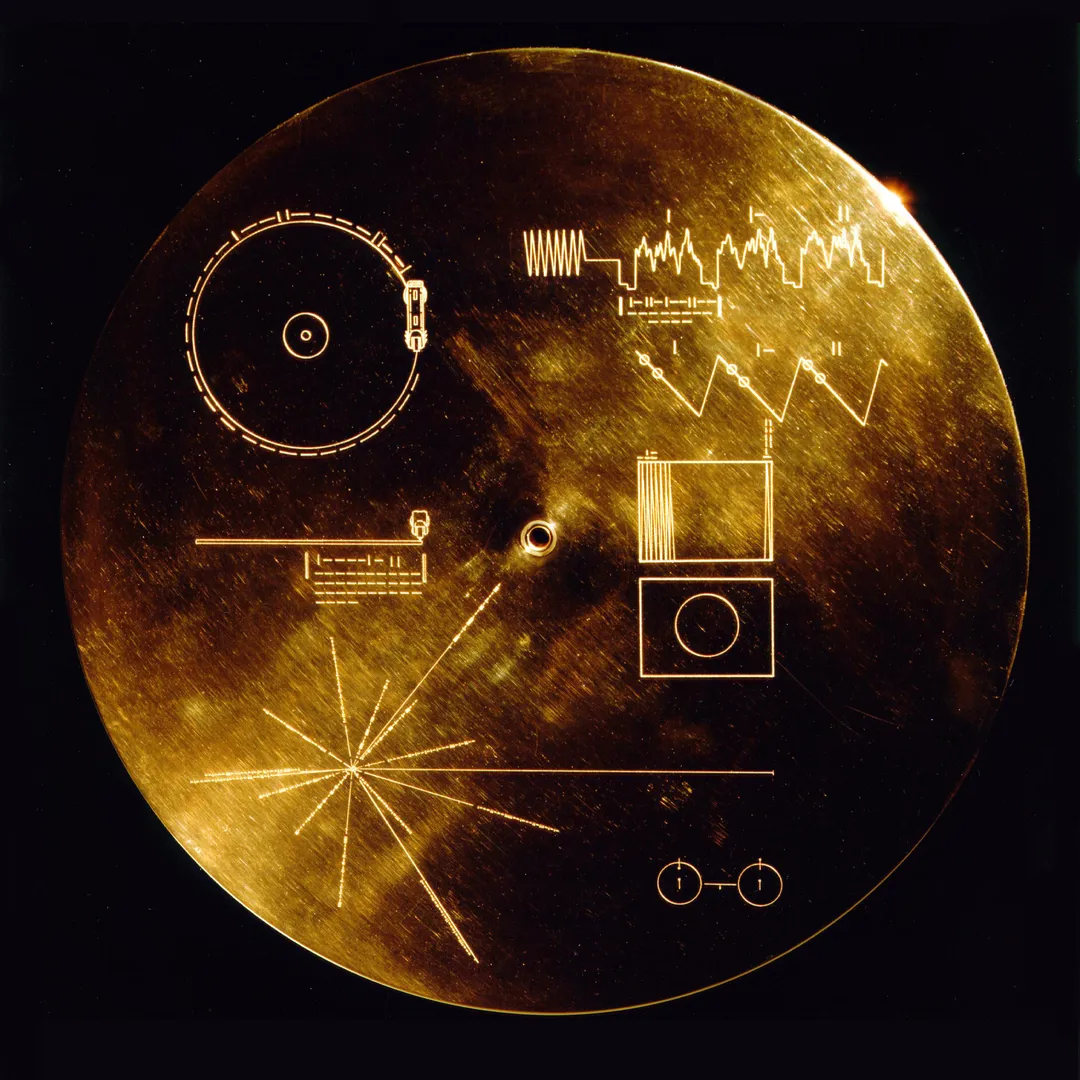
Look for the circle on the right half of the cover. It’s easy to miss beside the stylus and that starburst taking up much of the lower left. Yet if someone ever manages to coax a picture out of the groove, this is where they’ll have to look to see how they did.
In 1977 the two Voyager spacecraft left Earth carrying a record apiece. On board were music, voices and pictures. Even playing a greeting involved a rather awkward design brief. How do you show someone where to set a needle when you can’t assume they’ll recognise a drawing of a record? Frank Drake devised the diagram and Jon Lomberg drew it. They had the surface of a record cover to work with and one extraordinary advantage. They could put something in the groove that matched a mark on the outside.
How long is one turn?
At the top left, the needle meets the outer edge. Marks around the disc give the time it should take to turn once. Write “3.6 seconds” and you owe your reader an explanation of a second. Another small drawing, down on the right, supplies a unit. It shows two states of a hydrogen atom. The transition between them gives a timing reference that someone far from Earth could reconstruct.
There’s a lovely piece of layout here. The information you need to get the record turning occupies two corners of the cover. One gives you a gesture you could make with your hand. The other gives you the physics that makes sense of the number. Reading means moving back and forth between them.
When the circle comes out oval
The pictures are in the groove too, encoded as a signal. To see one, you have to build it up from 512 vertical lines. You could recover every last line and still space them too far apart. A picture would appear, stretched sideways. Imagine starting with a human portrait. How wide should an earthling’s face be, anyway?
A circle gives the reader a way to settle the question. Compare the shape recovered from the record with the one engraved on the cover. An oval means the proportions need adjusting. The first picture does a small job on behalf of every picture that follows.
Think about the last time you assembled a piece of furniture from a leaflet. At what point did you know you were getting it right? Probably when the thing in your hands finally looked like one of the drawings. The Voyager cover makes room for a moment like that, for a reader whose hands we can’t even picture.